
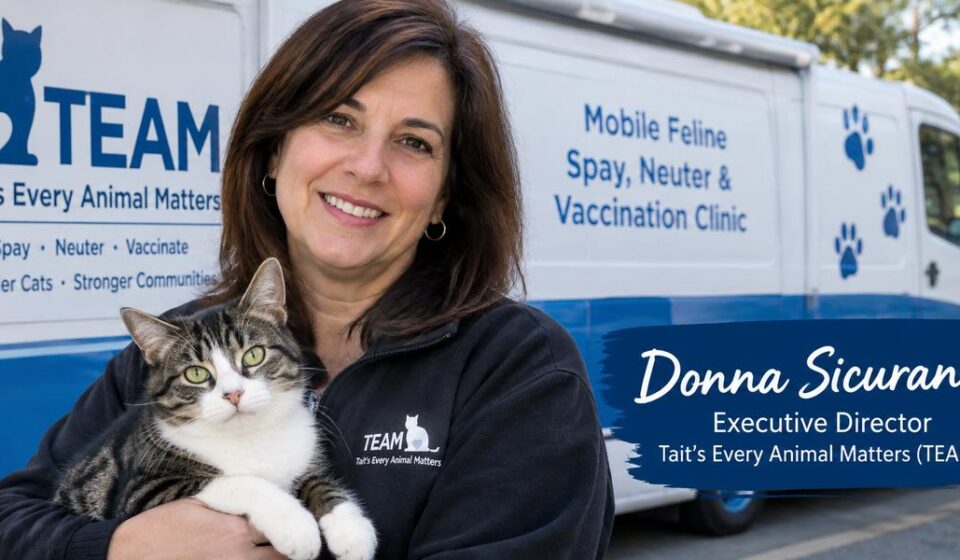

If you have searched this name online, you have probably noticed something confusing: two different women share it. One lived a quiet family life in New York and passed away in 2017. The other is a nonprofit leader who has spent almost thirty years helping cats in Connecticut get affordable veterinary care. This article is about the second woman — the nonprofit executive whose name is tied to a well-known mobile cat clinic.
Donna Sicuranza is best known as the Executive Director of Tait’s Every Animal Matters, a Connecticut charity that almost everyone in the state simply calls TEAM. Her work is not flashy. It is steady, practical, and focused on one goal: making it easier and cheaper for cat owners to get their pets spayed, neutered, and vaccinated. Today, in 2026, her organization’s mobile clinic has served well over 225,000 cats since it first hit the road in 1997. This guide walks through her career, her leadership at TEAM, and why her story matters to anyone who cares about animal welfare.
Who Is This Connecticut Nonprofit Leader?
Donna Sicuranza is an American nonprofit executive whose public work centers on animal welfare in Connecticut. She holds the title of Executive Director at Tait’s Every Animal Matters, and in some more recent records she is listed under the fuller professional name Sicuranza Marconi. Either way, the organization and the mission are the same.
Unlike a celebrity, she did not build a public brand around herself. Her name became known because of the work her organization does, not the other way around. People who search for information about her are usually cat owners, animal rescue volunteers, students researching nonprofit leadership, or journalists covering local charities. She is not a veterinarian and does not perform surgery herself. Instead, she manages the people, money, scheduling, and partnerships that keep a mobile veterinary clinic running smoothly across an entire state, five days a week and sometimes on Saturdays too.
This distinction matters for accuracy. Many biography-style websites blur her story with details about the New York woman who shares her name, which creates confusion for readers trying to learn the real facts.
Early Career: From Writing and PR to Nonprofit Leadership
Before she became known for animal welfare work, her career began in writing, editing, and public relations. These are not the skills most people expect from someone who later ran a mobile veterinary program, but they turned out to be exactly what the role needed.
Running a nonprofit is not just about compassion for animals. It also requires clear communication with donors, local governments, veterinary staff, and the public. Grant applications need to be written well. Newsletters need to explain complicated programs in simple terms. Press releases need to convince local newspapers that a story about affordable cat care is worth covering.
Her communications background gave her an advantage in all of these areas. It also helped her build trust with donors and community partners, which is often the hardest part of running a small nonprofit. Trust takes years to build and can be lost quickly, so consistent, honest communication became one of the quiet foundations of her career.
By the time she stepped into nonprofit leadership full time, she already understood how to tell a clear story about why the work mattered — a skill that turned out to be just as important as any spreadsheet or budget plan.
The Birth of TEAM: Tait’s Every Animal Matters
Tait’s Every Animal Matters, known as TEAM, started in 1997 with a simple but ambitious idea: bring affordable spay, neuter, and vaccination services directly to cat owners instead of expecting them to find and afford a traditional veterinary clinic.
On the very first day the mobile unit operated, a small team treated somewhere around ten to twelve cats out of a specially outfitted van. It was a modest start for what would grow into one of Connecticut’s most recognized feline welfare programs.
The organization is headquartered in Westbrook, Connecticut, and today operates from a fixed base while also sending its mobile unit to towns across the state. TEAM’s core belief is simple: preventing unwanted litters through spay and neuter surgery does more to reduce animal suffering than almost anything else a small charity can do. This approach lines up with guidance from national veterinary and animal welfare organizations, including the ASPCA’s own research on spay and neuter programs, which links these surgeries to healthier, longer lives for cats and fewer animals ending up homeless.
How the Mobile Feline Clinic Actually Works
The mobile clinic is the heart of TEAM’s mission. Instead of asking cat owners to travel to a clinic, the van travels to them, visiting different Connecticut towns on a rotating schedule throughout the week.
Each appointment includes a brief health exam, the spay or neuter surgery itself, core vaccinations such as rabies and distemper, a nail trim, and ear mite treatment if needed. Kittens have their own service package, and the clinic also offers booster shots and basic parasite prevention for cats that already had their surgery done elsewhere.
Rabies vaccination is a particularly important part of this work. Public health agencies such as the Centers for Disease Control and Prevention note that keeping pets current on rabies vaccines is one of the most effective ways to protect both animals and people from this serious disease. By folding vaccination into every visit, TEAM’s clinic quietly supports public health goals that go well beyond individual pet care.
Feral and community cats are also welcome, usually brought in humane traps by volunteer caretakers. This part of the program addresses one of the toughest challenges in animal welfare: unowned cat colonies that reproduce quickly without any intervention.
TEAM’s Growth Timeline
| Year | Milestone |
|---|---|
| 1997 | Mobile feline clinic launches with its first appointments in Connecticut |
| Early 2000s | Clinic schedule expands to cover more towns across the state |
| 2017 | Organization surpasses 200,000 cats served |
| 2020s | Clinic adds booster vaccine days and expanded kitten packages |
| 2026 | More than 225,000 cats served since the program began |
Leadership Style and Daily Responsibilities
Leading a mobile veterinary nonprofit is a balancing act. On any given day, the role can involve coordinating veterinary staff schedules, managing a fleet of specialized vehicles, applying for grants, handling insurance and compliance paperwork, and answering calls from worried pet owners.
Those who study nonprofit management often point out that executive directors of small charities wear far more hats than people expect. There is no large back office. One person may review budgets in the morning, meet with a town official about a parking location in the afternoon, and help plan a donor newsletter by evening.
Donna Sicuranza’s approach appears to favor steady, unglamorous consistency over public attention. TEAM’s growth over nearly three decades suggests a leadership style built on reliability rather than reinvention — showing up in the same towns, year after year, so pet owners know exactly what to expect.
This kind of leadership rarely makes headlines, but it is often what keeps small nonprofits alive long enough to make a real difference. Community trust, built one appointment at a time, is arguably TEAM’s most valuable asset.
Clearing Up a Common Name Mix-Up
Search engines often blend the stories of two unrelated women who happen to share the same name. It is worth stating clearly: Donna Sicuranza, the Connecticut nonprofit executive discussed throughout this article, is not the same person as Donna Marie Sicuranza, who lived in Mount Vernon and New Rochelle, New York, worked for decades in banking, and passed away in 2017 at age 74.
These two women never had any documented connection to each other. They simply shared a first and last name, which search engines and some low-quality biography sites have carelessly combined into one confused profile.
Getting this right matters for basic accuracy and respect. Mixing up two people’s life stories does a disservice to both — one deserves recognition for her nonprofit work, and the other deserves to be remembered accurately for her own family and career. Readers researching either woman should look for sources that clearly separate the two rather than blending details together.
Recognition, Challenges, and What Sets TEAM Apart
Small nonprofits rarely receive national media attention, and TEAM is no exception. Its recognition mostly comes from within Connecticut: word-of-mouth praise from pet owners, mentions in local news coverage, and steady referrals from animal shelters and rescue groups across the state.
Like most nonprofits that rely on mobile services, TEAM faces real operational challenges. Vehicles need regular maintenance. Fuel and veterinary supply costs rise every year. Staffing a traveling clinic is harder than staffing a fixed location, since the team must plan routes, secure parking permissions, and manage weather delays.
What sets the organization apart is its narrow, consistent focus. Rather than trying to do everything animal welfare related, TEAM has stayed centered on one clear mission for almost thirty years: affordable feline spay, neuter, and vaccination services. That kind of focus is rare, and it has likely contributed to the program’s long survival compared with broader charities that sometimes struggle to sustain multiple programs at once.
Online reviews are mixed, as they are for most busy nonprofit clinics operating on tight budgets and high demand, but the overall volume of repeat, grateful customers points to a program that has earned real community loyalty over time.
Legacy in 2026 and What Comes Next
Nearly three decades after that first day on the road, TEAM’s mobile clinic remains active across Connecticut in 2026, still following the same basic model that started it all: bring the van to the cats, not the other way around.
The legacy here is less about personal fame and more about sustained, practical impact. Hundreds of thousands of cats have been treated, thousands of pet owners have saved money on essential veterinary care, and countless feral cat colonies have been kept from growing unchecked. For a nonprofit built around a modest mobile unit, that is a significant accomplishment.
Looking ahead, organizations like this one will likely keep playing an important role in animal welfare, especially as veterinary costs continue to rise nationwide and traditional clinics stay overbooked. Mobile, low-cost models offer a practical middle ground between full-price private care and overwhelmed shelter systems.
For anyone studying nonprofit leadership, community health programs, or animal welfare policy, this story offers a useful, real-world example of how patient, focused leadership can build something that quietly outlasts trends and headlines. If you want to learn more about how affordable veterinary programs are structured, our guide to low-cost spay and neuter programs in the United States breaks down how similar clinics operate in other states.
Frequently Asked Questions
Who is Donna Sicuranza?
She is the Executive Director of Tait’s Every Animal Matters (TEAM), a Connecticut nonprofit running a mobile feline spay, neuter, and vaccination clinic since 1997.
Is she a veterinarian?
No. She manages administration, planning, and fundraising, while licensed veterinary staff perform all medical exams and surgeries.
How many cats has TEAM helped?
As of 2026, TEAM’s mobile clinic has served more than 225,000 cats across Connecticut since it began in 1997.
Are there two different people with this name?
Yes. A New York woman named Donna Marie Sicuranza, who worked in banking, passed away in 2017 and is unrelated to the nonprofit leader profiled here.
Where does TEAM’s mobile clinic operate?
TEAM is based in Westbrook, Connecticut, and its van travels to towns across the state on a rotating weekly schedule.
Final Thoughts
Donna Sicuranza’s story is a reminder that meaningful impact does not always come with a public spotlight. For nearly thirty years, her steady leadership at Tait’s Every Animal Matters has kept a mobile veterinary clinic running across Connecticut, helping more than 225,000 cats along the way. Her background in writing and communications, paired with a clear, unwavering mission, has helped TEAM grow into a trusted name for affordable pet care in the state.
Her work also offers a useful lesson for anyone interested in nonprofit leadership: consistency, clear communication, and a narrow focus can matter more than flash or fame. If you care about animal welfare, consider supporting a local low-cost spay and neuter program near you, or check whether a mobile clinic like TEAM’s community cat resources page serves your area. Every appointment, one cat at a time, adds up to real change.