

Introduction
Every day, billions of people type a question into a box and expect an answer in less than a second. Most never stop to wonder how that magic actually happens. Behind every search, there is a huge, quiet system of computers working together to find, sort, and rank information from across the entire internet.
This guide breaks down search engine basics in plain, simple words — no confusing tech jargon, no long-winded theory. Whether you are a student, a small business owner, a blogger, or just someone curious about how Google finds what you need, this article will walk you through the whole process step by step.
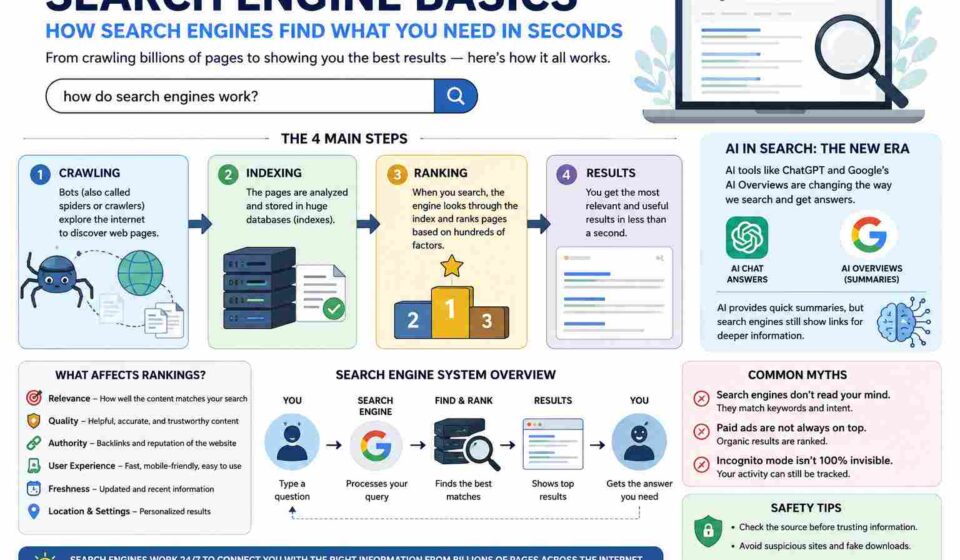
By the end, you will understand how search engines discover web pages, how they decide which ones deserve the top spot, and how things have changed now that AI tools like ChatGPT and Google’s AI Overviews are part of everyday searching. We will also cover common myths, safety tips, and a simple visual breakdown so you can see the big picture at a glance.
Let’s get started.
What Is a Search Engine, Really?

A search engine is a tool that helps you find information on the internet. Think of it like a giant digital library, except instead of a librarian, computer programs do all the searching for you. When you type a question or a few words into Google, Bing, or Yahoo, the search engine scans through billions of stored web pages and shows you the ones it thinks answer your question best.
A search engine is made up of two main parts. The first is an index, which is a massive digital storage system holding information about webpages. The second is an algorithm, a set of computer instructions that decides which pages match your search and in what order they should appear.
Search engines exist because the internet is too big for any human to organize by hand. There are more than a billion websites online today, and new pages are published every second. Without a system to sort through all that content, finding useful information would be almost impossible.
Most search engines also make money through advertising. When you see a “Sponsored” or “Ad” label above the regular results, that business paid to appear there. The results below those ads are called organic results, and no one can pay to rank higher in that section — they have to earn their spot through quality content and good on-page SEO.
Search Engine Basics: The Three Core Steps
Once you understand the three core steps behind every search engine, the rest becomes much easier to follow. These steps are crawling, indexing, and ranking, and they happen in that exact order, every single time.
First, a search engine has to discover that a page exists. It does this through crawling, which we will explain in detail shortly. Second, it has to understand and store what that page is about, a step called indexing. Third, whenever someone types a search query, the engine has to decide which stored pages are the most useful and arrange them in order, which is called ranking.
Learning these search engine basics helps you see why some websites show up on page one while others never appear at all. It is not random or based on luck. A page needs to be found, correctly understood, and judged as helpful and trustworthy before it can rank well.
This three-step process also explains why brand-new websites often take time to appear in search results. A page has to be crawled and added to the index before it even has a chance to be ranked. If your site is new, patience really is part of the process — along with solid keyword research so the search engine knows exactly what your content is about.
How Crawling Works
Crawling is the discovery stage. Search engines use automated programs called crawlers, spiders, or bots to travel across the web and find new or updated pages. Google’s crawler is known as Googlebot.
Here is a simple way to picture it: imagine a bot starting at one webpage, then following every link on that page to reach new pages, then following the links on those pages too. This process repeats endlessly, which is how crawlers manage to reach billions of pages across the internet.
Crawlers usually find new pages in three main ways:
- Through links. If an already-known page links to a new page, the crawler can follow that link to discover it.
- Through sitemaps. A sitemap is a file that website owners create to tell search engines which pages exist and which ones matter most.
- Through direct submission. Site owners can request that a specific page be crawled using tools like Google Search Console.
Not every page gets crawled instantly. Search engines have limited resources, so they prioritize pages that seem important, popular, or frequently updated. A site with broken links, slow loading speed, or blocked crawler access may struggle to get fully crawled, which means parts of it may never even make it into the search results.
How Indexing Works
Once a page has been crawled, the search engine needs to figure out what that page is actually about. This stage is called indexing, and it works a bit like adding a new book to a library catalog.
During indexing, the search engine analyzes the text, images, videos, and structure of a page. It looks at headings, keywords, and even the words used in links pointing to that page. It also checks whether the content is unique or simply a copy of something already indexed elsewhere.
Only pages that make it into the index can ever appear in search results. If a page is not indexed, it is essentially invisible to searchers, no matter how well it is written. This is why checking your site’s indexing status is one of the most important habits for anyone managing a website.
Modern search engines also render pages, meaning they load the page the way a browser would, including any JavaScript-based content. This helps them understand pages that use dynamic elements rather than plain, static text.
A helpful table can make this whole process much easier to remember, which we will cover shortly in the visual summary section below.
Search Fundamentals at a Glance: Two Quick-Reference Tables
Sometimes a simple table explains things faster than paragraphs of text. Understanding search engine basics becomes much easier when you can see the process and the players laid out side by side.
Table 1: The Three-Step Search Process
| Step | What Happens | Simple Example |
|---|---|---|
| Crawling | Bots discover new or updated pages by following links | A crawler finds your new blog post through a link on your homepage |
| Indexing | The page’s content is analyzed and stored in a massive database | Your blog post is added to Google’s index |
| Ranking | Algorithms sort indexed pages by relevance and quality for a search query | Your post appears on page one for a related search |
Table 2: Major Search Engines and Their Approximate Global Share (2026)
| Search Engine | Owner | Known For |
|---|---|---|
| Alphabet | Largest global market share, AI Overviews, PageRank-based ranking | |
| Bing | Microsoft | Powers Copilot, strong integration with Windows |
| Yahoo | Yahoo Inc. | Uses Bing’s index for most results |
| DuckDuckGo | DuckDuckGo | Focused on user privacy, no tracking |
| Baidu | Baidu Inc. | Dominant search engine in China |
These tables show that even though several search engines exist, they all follow the same basic process of finding, storing, and ranking content, just with different priorities and audiences.
How Ranking Works
Ranking is the final and arguably the most complex step. Once a query is typed, the search engine’s algorithm scans the index and decides which pages best match the searcher’s intent, then arranges them in order.
Search engines never reveal every ranking factor, but a few are widely known and confirmed. Relevance is one of the biggest — does the page’s content actually answer the question being asked? Quality and trustworthiness matter too, often judged by expertise, accuracy, and how other trusted sites link to that page. Page speed, mobile-friendliness, and overall user experience also play a role, especially since most searches now happen on phones.
Freshness matters for some searches but not others. If you search for “latest phone release,” you expect recent results. But if you search for “how photosynthesis works,” an older, well-written explanation works just fine.
Search engines also personalize results based on your location, language, and past search history. That’s why two people searching the same term in different cities might see slightly different results, especially for local searches like restaurants or shops nearby.
How AI Has Changed Search in 2026
Searching today looks quite different from a decade ago. AI-generated summaries, often called AI Overviews, now appear directly at the top of many results, giving users a quick answer without needing to click through to a website. Voice search has also grown, since more people speak naturally to their devices instead of typing short keyword phrases.
AI chat tools such as ChatGPT, Gemini, and Perplexity add a new layer to how people find information. Many still rely on existing search indexes to fetch and summarize current information, which means traditional search fundamentals still matter even in an AI-driven world. Industry analysts note that search has grown more conversational and answer-driven, with buyers now asking detailed questions instead of typing short keyword phrases into a search bar.
This shift doesn’t mean search engines are disappearing. It means being crawlable, well-organized, and genuinely useful matters more than ever, since both search engines and AI tools depend on the same underlying web content to generate their answers.
Search Engines vs. AI Chat Assistants: What’s the Difference?
It’s easy to confuse traditional search engines with AI chat assistants, since both help you find information. But they work differently under the hood.
A traditional search engine returns a list of links, letting you choose which website to visit and read. It relies almost entirely on its index and ranking algorithm, built from crawling the web.
An AI chat assistant, on the other hand, often generates a direct written answer by pulling together information from multiple sources, sometimes citing them and sometimes not. Many AI systems still depend on search technology behind the scenes to gather current information, especially for questions about recent events or specific facts.
For everyday users, this means you now have two main paths to find information: clicking through search results yourself, or asking an AI assistant for a summarized answer. Both paths ultimately rely on the same foundation — a well-indexed, well-organized web. This is exactly why solid technical SEO practices remain valuable for website owners, regardless of which method people use to discover their content.
Frequently Asked Questions
What are search engine basics in simple terms?
Search engine basics are the core steps — crawling, indexing, and ranking — that let a search tool find, store, and sort webpages so people can locate useful information quickly.
Which search engine is the most popular in 2026?
Google remains the most widely used search engine worldwide, though Bing has grown thanks to its integration with Microsoft’s AI tools like Copilot.
Do search engines and AI chatbots work the same way?
Not exactly. Search engines list ranked links, while AI chatbots often generate a direct summarized answer, though many still rely on search data behind the scenes.
Can I make my website appear higher in search results for free?
Yes, through organic SEO practices like helpful content, good site structure, and earning trustworthy backlinks, without paying for ads.
Why doesn’t my new website show up in search results yet?
New pages must first be crawled and indexed before they can rank, which can take anywhere from a few days to several weeks depending on the site.
Conclusion
Search engines might feel like magic, but they actually run on a clear, logical system: discover pages through crawling, understand and store them through indexing, then sort them through ranking to answer real user questions. Learning these fundamentals gives you a much clearer picture of why some websites succeed in search results while others struggle, and it helps you become a sharper, more confident searcher yourself.
As AI tools continue to reshape how people find information, the core ideas behind good search engine basics remain just as relevant as ever — helpful content, easy access for crawlers, and genuine trustworthiness still form the foundation of everything that follows.